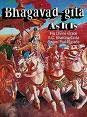
Lord Sri Krishna said – Never was there a time when I did not exist, nor Arjuna, nor all the kings in the battlefield; nor in the future shall any of us cease to be.
The Lord clearly stated that He Himself, His associate Arjuna and all the kings who were assembled on the battlefield were eternally individual beings. It is not that they did not exist as individuals in the past, and it is not that they will not remain eternal persons in future. Hence there was no cause for lamentation for anyone.
As confirmed by the Vedas, the Lord is eternally the maintainer of every individual living entities both in their conditioned as well as in their liberated situations. Hence this principle is applicable for every individual. Lord Krishna as the Supreme authority does not support the theory that after liberation the individual soul, separated by the covering of maya or illusion, merges into the impersonal Brahman and loses its individual existence.
Lord Krishna’s statement is authoritative because He is no ordinary personality. He is beyond the four common defects of human frailty – to commit mistakes, to be under illusion, propensity to cheat and be cheated and to have imperfect senses. The conclusion that soul is individual and eternal is confirmed by great acaryas like Sri Ramanujacarya, Madhvacarya and others.
A devotee can understand the mysticism of Bhagavad-gita because he accepts Lord Krishna. A non-devotee envies the very existence of the Lord and his understanding of Gita is like licking a bottle of honey, without actually getting the taste of honey. Just like one can have a taste of honey once one opens the bottle, similarly one can understand Bhagavad-gita if one accepts Lord Krishna as Supreme and eternal and all souls as His fragmental parts and individually eternal.
Saturday, February 6, 2010


Saturday, January 23, 2010
Bhagavad-gita 2.10 – 2.11 Lord Sri Krishna begins rendering Bhagavad-gita

Lord Sri Krishna began rendering Bhagavad-gita to the grief-stricken Arjuna. As Hrsikesa, the controller of senses, the Lord began delivering the Absolute principles to wipe out the lamentation of His disciple. Arjuna had voluntarily become a student of his Friend and Lord Sri Krishna at once assumed the role of Spiritual Master. The talks were openly exchanged in the presence of both armies for the benefit of all.
The Supreme Personality of Godhead chastised the student calling him indirectly a fool. Arjuna was talking like a learned man but was indeed ignorant. Arjuna argued that religious principles should be given more importance than politics and sociology but he did not know that knowledge of matter, soul and the Supreme is even more important than religious formalities.
Arjuna was lacking in knowledge and hence he was lamenting for something worthless. The body is born and gets destroyed ultimately; hence the body is temporary and not as important as the soul. Learned is one who knows the difference between body and soul and does not lament for the living or death of the body.
Lord revealed Sankhya philosophy on what is body and what is soul in verses 2.11 – 2.30 while explaining why Arjuna should not grieve for any living being. Principles of body and soul applied to even Bhismadeva and Dronacarya. There was no cause for lamentation regardless of the condition of their material body.
There are different stages of knowledge - pratyaksa, aparoksa, pratyaksa paroksa aparokṣa, adhoksaja, aprakṛta. In the gross bodily platform we demand pratyaksa-jnanam which means direct perception. So-called scientists believe in pratyaksa praman or experimental knowledge based on gross sense perception. Knowledge acquired in the bodily platform through direct perception is not real knowledge. God is not a subject matter that one can see with pratyakṣa direct perception. God's another name is anubhava and is realized in aparokṣa stage. Just like we do not see the sun directly in a room during daytime although we know that there is the sun. He can be estimated from His creation. Further consciousness about Lord Sri Krishna means adhokṣaja and aprakṛta that is beyond the senses. Anubhava can therefore be obtained through sruti or srota-pantha or hearing from vedic literature as rendered by bona-fide spiritual master. This process as exibited by Bhagavad-gita can dissipate ignorance.
Friday, January 15, 2010
Bhagavad-gita 2.4 – 2.9 Arjuna remains perplexed and surrenders to Lord Krishna for solution

Arjuna claimed that it would be better to live in this world by begging than to live at the cost of lives of great souls. Even though desiring worldly gain, they were superiors. If they were killed, the victory would be tainted with blood. He even did not care to live. Arjuna was pious in nature and did not yearn for unwnated victory.
Arjuna then accepted - kärpanya-dosopahata-svabhävah – “Now I am confused about my duty and have lost all composure because of miserly weakness. I am asking You to tell me for certain what is best for me.”
He understood that he had become “krpanah” or miserly. Such persons waste their time in being overly affectionate for family, society, country, etc., in the material conception of life. This is like “skin disease.” The krpanah thinks that he is able to protect his family members from death; or that his family or society can in turn save him from the verge of death. Such family attachment can be found even in animals.

sisyas te ‘ham sädhi mäm tväm prapannam - Arjuna therefore offers himself as a disciple to Lord Krishna, the supreme spiritual master. Before the war Arjuna knew Krishna as his friend, relative and age-mate. But now he wanted to stop friendly talks. Arjuna wanted to talk very seriously before the recognized spiritual master. He resolved - na yotsya iti govindam – “Govinda I shall not fight” and surrendered unto the Lord for true knowledge.
Tuesday, January 12, 2010
Bhagavad-gita 2.2-3 Lord Krishna chastised Arjuna because of his weak behaviour

Lord Krishna did not approve of the so-called compassion or false magnanimity of Arjuna for his kinsmen. People do not know where compassion should be applied. Material compassion, lamentation and tears are all signs of ignorance of the real self. Compassion for the eternal soul is self-realization.
For example, compassion for the dress of the drowning man is senseless. Outward dress is compared to the gross material body. A man fallen in the ocean of nescience cannot be saved simply by rescuing his outward dress or the gross material body. One who does not know this and laments for the outward dress is called a sudra or one who laments unnecessarily. Such a person does not attain opulences but only infamy.
Lord Krishna further chastises Arjuna - klaibyam mä sma gamah pärtha - do not yield to this degrading impotence. Only a Friend can call His friend impotent. Arjuna was being guided by the Lord Himself to overcome his weakness and to reveal the knowledge of liberation from material bondage.
Tuesday, January 5, 2010
Six Opulences of Sri Bhagavan or Supreme Personality of Godhead

aiswarasya samägrasya viryasya yasasah sriyah
jnäna vairägyayos caiva sannam bhaga itingana … Visnu Purana 6.5.47
The Supreme Personality who possesses all aiswarya or riches, all virya or strength, all yasa or fame, all sri or beauty, all jnana or knowledge and all vairagya or renunciation is called Bhagavan.
There are many persons who are very rich, very powerful, very beautiful, very famous, very learned and very much detached, but no one can claim that he possesses all riches, all strength etc. entirely. Only Lord Krishna can claim this because He is the Supreme Personality of Godhead. No living entity, including Brahma, Lord Shiva or Narayana, can possess all opulences as fully as Krishna.
It is concluded in the Brahma-samhita by Lord Brahma himself that Lord Krishna is the Supreme Personality of Godhead. No one is equal to or above Him. He is the primeval Lord, or Bhagavan, known as Govinda, and He is the supreme cause of all causes.
In the Srimad Bhagavatam also there is a list of many incarnations of the Supreme Personality of Godhead, but Lord Krishna is described as the original Personality of Godhead, from whom many, many incarnations and Personalities of Godhead expand.
Acaryas including Adi Sankaracarya, Ramanujacarya, Madhavacarya and Sri Caitanya Mahaprabhu Himself have accepted Lord Krishna or Govinda as the Supreme Personality of Godhead or Bhagavan.
Friday, January 1, 2010
Bhagavad-gita Chapter-2 Lord Sri Krishna begins speaking Bhagavad-gita
Bhagavad-gita Chapter-2 is a summary of the gita itself. After presenting the condition of living beings - both good and bad - in Chapter-1, Lord Sri Krishna reveals the essence of Bhagavad-gita in Chapter-2.

uväca madhusudanah - Lord Madhusudana or Lord Krishna begins speaking Bhagavad-gita … BG 2.1
sri-bhagavän uväca – The Supreme Personality of Godhead, Lord Sri Krishna said … BG 2.2
Lord Krishna and the Supreme Personality of Godhead are identical. Therefore Lord Krishna is referred to as Bhagavan throughout the Gita. Bhagavan is the ultimate in the Absolute Truth. Absolute Truth is realized in three phases of understanding as explained by Srimad Bhagavatam, namely - Brahman or the impersonal all pervasive spirit, Paramatma or the localized aspect of the Supreme within the heart of all living entities, and Bhagavan or the Supreme Personality of Godhead, Lord Krsna.

The three divine aspects of Sri Bhagavan can be explained by the example of the sun, which also has three different aspects, namely - the sunshine, the sun’s surface and the sun planet itself.
One who studies the sunshine only is the preliminary student. Ordinary students who are satisfied by simply understanding the sunshine – its universal pervasiveness and the glaring effulgence of its impersonal nature – may be compared to those who realize only the Brahman feature of the Absolute Truth. This is the realization of brahmajyoti or effulgence emanating from the Lord.
One who understands the sun’s surface is further advanced. The student who has advanced still further can know the sun disc, which is compared to knowledge of the Paramatma feature of the Absolute Truth. This is the realization of Supersoul in the heart and the all-pervasiveness of the Lord in all living and non-living entities.
One who can enter into the sun planet is the highest. Such student who can enter into the heart of the sun planet is compared to those who realize the personal features of the Supreme Absolute Truth. This is the realization of the relationship with the Lord as His servant, friend, parent or paramour.
The sunshine, the sun disc and the inner affairs of the sun planet cannot be separated from one another, and yet the students of the three different phases are not in the same category. Therefore, the bhakta or the transcendentalist who has realized the Bhagavan feature of the Absolute Truth is the topmost.


sri-bhagavän uväca – The Supreme Personality of Godhead, Lord Sri Krishna said … BG 2.2
Lord Krishna and the Supreme Personality of Godhead are identical. Therefore Lord Krishna is referred to as Bhagavan throughout the Gita. Bhagavan is the ultimate in the Absolute Truth. Absolute Truth is realized in three phases of understanding as explained by Srimad Bhagavatam, namely - Brahman or the impersonal all pervasive spirit, Paramatma or the localized aspect of the Supreme within the heart of all living entities, and Bhagavan or the Supreme Personality of Godhead, Lord Krsna.

One who studies the sunshine only is the preliminary student. Ordinary students who are satisfied by simply understanding the sunshine – its universal pervasiveness and the glaring effulgence of its impersonal nature – may be compared to those who realize only the Brahman feature of the Absolute Truth. This is the realization of brahmajyoti or effulgence emanating from the Lord.
One who understands the sun’s surface is further advanced. The student who has advanced still further can know the sun disc, which is compared to knowledge of the Paramatma feature of the Absolute Truth. This is the realization of Supersoul in the heart and the all-pervasiveness of the Lord in all living and non-living entities.
One who can enter into the sun planet is the highest. Such student who can enter into the heart of the sun planet is compared to those who realize the personal features of the Supreme Absolute Truth. This is the realization of the relationship with the Lord as His servant, friend, parent or paramour.
The sunshine, the sun disc and the inner affairs of the sun planet cannot be separated from one another, and yet the students of the three different phases are not in the same category. Therefore, the bhakta or the transcendentalist who has realized the Bhagavan feature of the Absolute Truth is the topmost.

Wednesday, December 30, 2009
Glories of Bhagavad-gita Chapter-1 in Gita-mahatmya
Padma Purana records how Lord Siva informed his wife Parvati devi about what Lord Vishnu was telling His consort Lakshmi devi about Bhagavad-gita. Lord Vishnu himself manifested in the form of Bhagavad-gita. The first five chapters are His head, the next ten chapters His ten arms, the sixteenth chapter His stomach and the last two chapters His lotus feet. An intelligent person who daily recites one chapter or even one sloka, one half sloka, or at least one quarter sloka, will attain the supreme destination, Vaikuntha.
There was a brahmana named Susharma who was wicked and sinful. He took pleasure hurting others, drinking wine and eating flesh. One day he died from snake bite. He had to suffer in many hells and ultimately attained the body of a bull. A crippled man purchased the bull and made him carry heavy load on his back. One day the bull fell unconscious and many people gathered to watch him. Several pious people including a prostitute bestowed upon the bull the results of some of their pious activities. Later the bull died and was taken to Yamaraja, the god of death. Because of the pious credits given by the prostitute he took birth in a very high brahmana family. In that birth, he was able to remember his past birth and wanted to meet the prostitute. Later he met the prostitute and understood the reason for her purity.
There was another brahmana who was very proud of his learnings and used to insult other learned persons out of jealousy. After death he was cast into many hells and achieved the body of a parrot. The bird lost its parents when young and was left alone. It was given shelter by some rishi's in their ashrama. The children of the rishi's used to recite the first chapter of Bhagavad-gita and the parrot picked the slokas from them. He was later stolen by a thief and sold to the prostitute. Continuously hearing the recitation from the parrot, the prostitute became pure in heart.
Anyone who recites, hears or studies the first chapter of the Bhagavad-gita will very easily cross over the ocean of material miseries and attain the service of the lotus feet of Lord Krishna.
There was a brahmana named Susharma who was wicked and sinful. He took pleasure hurting others, drinking wine and eating flesh. One day he died from snake bite. He had to suffer in many hells and ultimately attained the body of a bull. A crippled man purchased the bull and made him carry heavy load on his back. One day the bull fell unconscious and many people gathered to watch him. Several pious people including a prostitute bestowed upon the bull the results of some of their pious activities. Later the bull died and was taken to Yamaraja, the god of death. Because of the pious credits given by the prostitute he took birth in a very high brahmana family. In that birth, he was able to remember his past birth and wanted to meet the prostitute. Later he met the prostitute and understood the reason for her purity.
There was another brahmana who was very proud of his learnings and used to insult other learned persons out of jealousy. After death he was cast into many hells and achieved the body of a parrot. The bird lost its parents when young and was left alone. It was given shelter by some rishi's in their ashrama. The children of the rishi's used to recite the first chapter of Bhagavad-gita and the parrot picked the slokas from them. He was later stolen by a thief and sold to the prostitute. Continuously hearing the recitation from the parrot, the prostitute became pure in heart.
Anyone who recites, hears or studies the first chapter of the Bhagavad-gita will very easily cross over the ocean of material miseries and attain the service of the lotus feet of Lord Krishna.
Friday, December 25, 2009
Bhagavad-gita Summary of Chapter-1 Duryodhana’s arrogance and Arjuna’s bewilderment
Bhagavad-gita is the essence of Vedic knowledge and rightly sets the stage in Chapter-1. On one hand there is Dhrtarastra and his demoniac son, Duryodhana showing arrogance due to their faith in military strength. On the other hand there is Arjuna, the devotee of the Lord but in bewildered condition out of attachment to family and friends. Arjuna is unwilling to fight and counter his family and friends in battle considering this to be sinful. Both good and bad are mired in the maze of material nature. Under this context, the perfect theistic science is revealed by Lord Sri Krishna for the ultimate benefit of all living beings.
In this material world, for every action there is counteraction. For every sinful action, there are reactions and sufferings. Any service done for the satisfaction of the self is sinful. There is danger lurking everywhere. However, if you are diseased, you have to take medicine. If somebody is drowning in the sea, you have to give him some help, send some boat or some lifeboat so that he can be saved. When you see written on a gate, “Danger! Beware of Dogs!” you avoid the place. How do we therefore counter from sinful reactions?
Anyone who has taken shelter of the lotus feet of Lord Krishna, He protects from all counteraction. If He instructs to fight for His mission, the ultimate good is to fully surrender to Him and comply with His words. In so doing, He Himself promises to remove all sins and dangers. The teaching was understood and realized by Arjuna, who heard the Bhagavad-gita directly from the Lord. This has to be understood “as it is” by hearing from bona-fide devotees.
In this material world, for every action there is counteraction. For every sinful action, there are reactions and sufferings. Any service done for the satisfaction of the self is sinful. There is danger lurking everywhere. However, if you are diseased, you have to take medicine. If somebody is drowning in the sea, you have to give him some help, send some boat or some lifeboat so that he can be saved. When you see written on a gate, “Danger! Beware of Dogs!” you avoid the place. How do we therefore counter from sinful reactions?
Anyone who has taken shelter of the lotus feet of Lord Krishna, He protects from all counteraction. If He instructs to fight for His mission, the ultimate good is to fully surrender to Him and comply with His words. In so doing, He Himself promises to remove all sins and dangers. The teaching was understood and realized by Arjuna, who heard the Bhagavad-gita directly from the Lord. This has to be understood “as it is” by hearing from bona-fide devotees.
Wednesday, December 23, 2009
Bhagavad-gita 1.41-46 Arjuna’s argument regarding concern for Forefathers and Family Welfare

Sometimes the forefathers may be suffering from various types of sinful reactions, and sometimes some of them cannot even acquire a gross material body and are forced to remain in subtle bodies as ghosts. Thus, when remnant of food or prasadam is offered to forefathers by descendants, the forefathers are released from ghostly or other kinds of miserable life.
Those who destroy the family tradition therefore commit sin. Hence such destroyers dwell always in hell. Therefore Arjuna was not willing to commit the great sin (maha-papam). He was ready to die unarmed rather than kill his family members (svajan).
Arjuna mistook that the war was arranged for his satisfaction so that he could enjoy the kingdom and the happiness thereof. Actually, it was not an ordinary activity since it was organized for the satisfaction of Lord Krishna’s mission. People under varnasrama-dharma are engaged in devotional life (life dedicated to serve Lord Vishnu or Lord Krishna). All welfare activities are fulfilled in such a society. It is even not required to perform rituals of offerings to forefathers since simply by performing devotional service, one can deliver hundreds and thousands of forefathers from all kinds of misery.
Friday, December 18, 2009
Bhagavad-gita 1.40 Arjuna’s argument regarding Concern for Women and Children
When irreligion is prominent in the family, O Krsna, the women of the family (kula-striyah) become polluted, and from the degradation of womanhood, O descendant of Vrsni, comes unwanted progeny (varna-sankara).

Good population in human society is the basic principle for peace, prosperity and spiritual progress in life. The varnasrama principles are so designed that the good population would prevail in society for the general spiritual progress of state and community. Such population depends on the chastity and faithfulness of its womanhood. We find such examples of satita in the example of Damyanti who was steadfast in her faith on her husband Nala even when he became poor because of a curse. Wife can also help one to be elevated to the heavenly planets, to advance in religious and spiritual knowledge, for economic development, for satisfying sense gratification and also for salvation.

On the failure of varnasrama-dharma, naturally the women become free to act and mix with men, and thus adultery is indulged in at the risk of unwanted population. Irresponsible men also provoke adultery in society, and thus unwanted children flood the human race at the risk of war and pestilence. Class of people born out of lust or adultery and undesirable parents are called varna-sankara. Hiranyakasipu, the demoniac asura was born when his mother Diti became lusty during an improper time of day for progeny.
Son or putra is expected to deliver the forefathers from the hellish condition of life through sraddha and pindam offerings. Arjuna was afraid that family will face irresponsible progeny after the deaths in the war.


Son or putra is expected to deliver the forefathers from the hellish condition of life through sraddha and pindam offerings. Arjuna was afraid that family will face irresponsible progeny after the deaths in the war.
Subscribe to:
Posts (Atom)